The Return of Great Rugby: South Africa vs New Zealand 2026 at the Heart of the Autumn Season
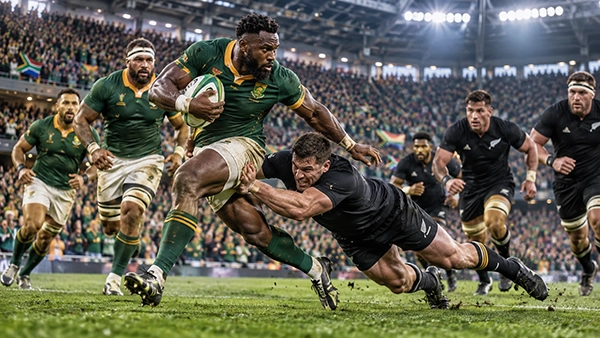
The 2026 series between South Africa and New Zealand did more than add four new Tests to one of rugby’s oldest rivalries. It restored the scale and continuity of a traditional international tour at a time when the modern calendar is usually built around short windows and individual fixtures. Between 7 August and 12 September, the All Blacks played eight matches, including four games against leading South African sides and four Tests against the Springboks. By the end of the programme, South Africa had recovered from defeat in the opening Test to win the series 3–1, closing it with a 43–28 victory in Baltimore. As of September 2026, those five weeks already stand out as one of the defining passages of the international season. They combined sporting history, modern Test rugby and a touring format rarely seen in the professional era, while setting an important reference point before the Bledisloe Cup and the European phase of the new Nations Championship later in the year.
Why South Africa vs New Zealand Became 2026’s Defining Rugby Series
South Africa and New Zealand hardly needed a new competition to make their meetings important. The countries first played each other in 1921 and have spent more than a century building a rivalry based on repeated contests between two of the strongest rugby cultures in the game. Together, the Springboks and All Blacks have won seven of the first ten men’s Rugby World Cups: four for South Africa and three for New Zealand. Their history contains long tours, famous Test series, World Cup meetings and matches decided by narrow margins, but the shape of international rugby gradually changed after professionalism. Long tours became unusual, domestic competitions became more demanding and national teams increasingly travelled for short series rather than spending several weeks in one country. That made the scale of the 2026 programme significant before the first ball was kicked.
The new Rugby’s Greatest Rivalry arrangement was created as an alternating tour to be staged every four years. The inaugural edition sent New Zealand to South Africa for the first full-scale All Blacks tour there since 1996. Four non-Test matches were placed around the Test programme, giving the Stormers, Sharks, Bulls and Lions the rare opportunity to face the All Blacks outside a normal international fixture. The Tests themselves were played at Ellis Park in Johannesburg on 22 August, DHL Stadium in Cape Town on 29 August and FNB Stadium in Johannesburg on 5 September before the teams travelled to the United States for the finale at M&T Bank Stadium in Baltimore on 12 September. Rather than a short two-match visit, the itinerary required New Zealand to live with South African conditions, opposition and travel for more than a month.
The timing also made the series particularly relevant to the wider 2026 calendar. Both countries had already played the first phase of the newly introduced Nations Championship during the July international window, while New Zealand still had the Bledisloe Cup against Australia in October and Nations Championship matches in Europe during November. The Springboks–All Blacks series therefore sat between major sections of the international year rather than operating as an isolated event. It gave coaches a prolonged opportunity to assess combinations, squad depth and the ability of players to perform repeatedly against high-quality opposition. For supporters, it created a continuing story across August and September rather than one headline Test followed immediately by a different opponent. That continuity helped make South Africa against New Zealand the central rivalry heading into the northern autumn programme.
How the Tour Revived an Older Rugby Tradition
One reason the tour felt different was the return of matches against regional opposition. For much of rugby history, touring sides did not simply arrive for a Test and leave. They faced provincial, regional or representative teams between internationals, which meant a successful tour depended on considerably more than the strongest starting XV. The 2026 itinerary brought part of that structure back. New Zealand opened against the Stormers in Cape Town, travelled to Durban to meet the Sharks and then went to Pretoria for the Bulls. After the first Springbok Test at Ellis Park, another All Blacks selection faced the Lions at the same ground only three days later. That schedule gave less experienced squad members meaningful minutes while keeping senior players involved in a demanding competitive environment over several weeks.
New Zealand handled the four franchise matches impressively. The All Blacks beat the Stormers 38–21 on 7 August, recorded a 54–0 win against the Sharks four days later and defeated the Bulls 50–19 at Loftus Versfeld on 15 August. The provincial section ended with a far less comfortable 41–35 victory over the Lions on 25 August. Those results gave New Zealand four wins from four outside the Tests, but they also illustrated why the longer format mattered. Different players had to start, combinations changed and the squad had to recover quickly between matches. The Lions game, staged only three days after the first Springbok Test, was particularly demanding. New Zealand fell well behind before recovering, providing the type of mid-tour examination that would simply not exist during a conventional two- or three-Test visit.
There was also clear evidence that supporters responded to the longer programme. New Zealand Rugby reported a total attendance of 380,105 across the South African part of the tour, covering the franchise matches and Tests. The Baltimore finale then attracted 68,173 spectators, reported by New Zealand Rugby as a record crowd for a rugby Test in the United States. Those figures do not mean that every future international series needs to copy the same format, but they demonstrate that there remains considerable interest in a tour built around an extended rivalry rather than unrelated fixtures. The significance was not only nostalgic. Longer tours create connections between international rugby and local teams, give supporters in several cities access to the visitors and allow a sporting contest to develop over weeks. In 2026, that older idea proved capable of working within a modern professional season.
Four Tests That Changed the Balance of the Rivalry
The opening Test at Ellis Park suggested that New Zealand might take control of the series. The All Blacks won 33–16 on 22 August, scoring five tries to South Africa’s one despite spending significant periods under pressure. Will Jordan crossed twice as New Zealand made better use of its attacking opportunities and repeatedly survived difficult passages without allowing the Springboks to build a decisive advantage. South Africa had periods of physical control, particularly around the scrum, but New Zealand remained composed and punished mistakes when space appeared. The final margin was substantial enough to change the mood of the series immediately. After several weeks of successful tour matches, the visitors had now beaten the Springboks in Johannesburg and held a 1–0 lead with three Tests remaining.
South Africa’s answer in Cape Town a week later was decisive. The Springboks won the second Test 33–26 despite New Zealand scoring four tries to South Africa’s three. Cheslin Kolbe played an unusual but crucial role with the boot, contributing 18 points through three conversions and four penalties. New Zealand had more possession and created several attacking opportunities, but the Springboks were more effective at converting pressure into points and defending the moments that mattered most. South Africa also used its replacements well as the match developed, ensuring that the intensity did not disappear late in the contest. New Zealand still had a chance to rescue the match near the end, but a South African turnover closed the final opportunity. Instead of allowing the visitors to build a two-Test lead, the Springboks had levelled the series at 1–1.
The third Test at FNB Stadium on 5 September shifted the series in South Africa’s favour. The Springboks won 29–24 after the sides had gone into half-time level at 12–12. New Zealand captain Ardie Savea scored two tries but left the match with a shoulder injury before the break, removing one of the All Blacks’ most influential players from a contest that became increasingly physical. South Africa established control during the second half through sustained pressure, with tries from Jesse Kriel and Malcolm Marx and a penalty try helping to create a 29–17 advantage. New Zealand responded late through Samisoni Taukei’aho, but there was not enough time to complete the recovery. With South Africa now leading 2–1, the All Blacks could no longer win the series outright. They travelled to Baltimore needing victory simply to finish level.
Baltimore Finale and the 3–1 South African Series Win
The fourth Test produced the highest-scoring match of the series and confirmed South Africa as the overall winner. At M&T Bank Stadium on 12 September, the Springboks beat New Zealand 43–28 after leading 17–14 at half-time. The All Blacks remained close during the first half, with Codie Taylor and Will Jordan scoring tries, but South Africa created separation soon after the interval. Malcolm Marx finished a lineout drive before Pieter-Steph du Toit added another try only a few minutes later. New Zealand responded through Ethan Blackadder, yet further South African scores from Kurt-Lee Arendse and Cameron Hanekom removed the possibility of a late comeback. Beauden Barrett crossed in the final minute, but by then the outcome was settled. South Africa had won three consecutive Tests after losing the opener and completed the four-match series with a 3–1 advantage.
Baltimore added another dimension to the rivalry because neither team was playing on traditional home ground. The 68,173 attendance showed that a Springboks–All Blacks Test could attract a major audience in the United States without being attached to a World Cup. That matters with the United States preparing to host the men’s Rugby World Cup in 2031. M&T Bank Stadium, normally home to the Baltimore Ravens of the NFL, gave the match the scale of a major American sporting event while retaining the identity of an international rugby Test. Moving the final game outside South Africa also prevented the tour from becoming purely domestic in its reach. After three Tests in Johannesburg and Cape Town, the rivalry was presented to a different market without changing the importance of the sporting contest.
Across the four Tests, the most striking feature was South Africa’s ability to change the direction of the series after a poor opening result. New Zealand continued to produce dangerous attacking rugby and scored 111 points across the four matches, but the Springboks became progressively better at controlling the periods when matches were tight. Their forwards generated pressure, their defence forced New Zealand to work for long passages and their replacements repeatedly helped maintain intensity. At the same time, players such as Kolbe, Kriel, Marx, Pieter-Steph du Toit and Sacha Feinberg-Mngomezulu made important contributions at different stages rather than leaving the series dependent on one individual. New Zealand had strong performances from Jordan, Savea, Cam Roigard and several emerging players, yet injuries and inconsistency made it harder to maintain the level shown in the opening Test.

What the Series Means for the Rest of the 2026 Season
The immediate value of the series is that both teams now possess unusually detailed information about where they stand against elite opposition. Four Tests against the same opponent expose strengths and weaknesses more clearly than a single match because each team has time to respond. South Africa lost the first Test, adjusted and then won three in succession. New Zealand saw that its attacking game could create tries against the Springboks, including four in Cape Town despite losing the match, but also experienced how difficult it can be to maintain control once South Africa establishes pressure over a sustained period. With the 2027 Rugby World Cup little more than a year away, those lessons are important. Coaches can review not only individual performances but how their squads reacted when the same opponent returned with a different approach the following week.
For New Zealand, attention now moves to another traditional rivalry. The All Blacks are scheduled to meet Australia at Eden Park on 10 October before the second Bledisloe Cup Test in Sydney on 17 October. The European section of the Nations Championship then follows, with matches against Scotland at Murrayfield on 7 November, Wales in Cardiff on 14 November and England at Allianz Stadium in London on 21 November. The inaugural Nations Championship Finals Weekend is scheduled for 27–29 November in London. That means the lessons from South Africa will remain relevant almost immediately. The All Blacks have little reason to abandon an attack that produced opportunities throughout the tour, but the 3–1 series defeat gives the coaching group clear evidence about areas that have to become more consistent before another run of high-level Tests.
South Africa leave the series with a different challenge. Winning three consecutive Tests against New Zealand establishes a strong standard, but it also ensures that future opponents have substantial recent evidence of how the Springboks operate. Success in modern international rugby rarely allows a team to stand still. The value of the 2026 series for South Africa therefore lies not simply in the trophy but in the number of players who contributed across four demanding matches. Different combinations were required, established internationals remained influential and newer options gained experience in matches carrying genuine pressure. The series demonstrated that the Springboks could recover from a heavy first-Test defeat without making the rest of the tour a reaction to one bad afternoon. That ability to adjust may prove as useful as any individual scoreline during the remainder of the season.
The Long-Term Legacy Beyond 2026
The 2026 tour was designed as the beginning of a continuing arrangement rather than a one-off anniversary event. Under the announced format, South Africa and New Zealand will alternate as hosts every four years. The next full tour is scheduled for 2030, when the Springboks are due to travel to New Zealand. It will be South Africa’s first full professional-era tour of the country, with their previous traditional tour having taken place in 1994. That future visit gives the rivalry a structure that extends beyond annual Test scheduling. Players and coaches will change, but the basic idea remains recognisable: an extended programme involving local opposition and a Test series that develops over several weeks rather than being compressed into a single weekend.
The strongest argument for retaining that idea is the sporting depth it created in 2026. The franchise games mattered because they forced New Zealand to use more of its travelling squad and allowed South African teams to measure themselves against the All Blacks. The four-Test format mattered because neither the 33–16 New Zealand victory at Ellis Park nor South Africa’s 33–26 response in Cape Town could define the entire contest. Each result changed the next selection, the next tactical discussion and the pressure surrounding the following Test. By the time the teams reached Baltimore, supporters were watching the final chapter of a five-week story rather than an isolated international. That difference is difficult to reproduce when major teams meet only once during a crowded window.
For that reason, the South Africa–New Zealand series deserves to be remembered as more than another set of results in the 2026 fixture list. South Africa’s 3–1 victory is the central competitive fact, but the broader importance lies in the return of a demanding tour, the involvement of four South African sides, the large crowds across several cities and the decision to take the final Test to the United States. The series also arrived at an ideal point in the season, setting a standard before the Bledisloe Cup and the major November internationals in Europe. International rugby in 2026 is changing through new competitions and a more connected calendar, yet one of the year’s strongest stories came from reviving an older idea. South Africa and New Zealand showed that an extended rivalry can still command attention, test entire squads and give a season a clear sporting centre.