
Traps of betting NHL favourites: when “logic” works against you
Backing the favourite in an NHL game often feels like the sensible move: stronger roster, better form, home ice, a star goaltender confirmed. The issue is that “more likely to win” is not the same as “good value at this price”. In a league where single-goal margins are common and results swing on special teams, goalie performance, and late-game randomness, short odds can punish small misreads.
The price is the opponent: favourites can be right and still be bad bets
Most people judge a bet by the final result, but the real question is whether the odds were fair at the moment you placed them. A favourite can win often and still lose you money if you keep paying a price that bakes in every obvious advantage. The market is usually aware of the same headlines you are: recent wins, star power, home record, and “must-win” narratives. If the price is already tight, you are effectively paying a premium for comfort.
This becomes especially clear when you translate odds into implied probability. Short prices leave very little room for error: one late penalty, one deflection, one unexpected goalie change, and the “safe” pick turns into a negative-value habit. Over a season, it is not one shock upset that matters most, but the repeated small overpayments that quietly drain your edge.
A practical discipline is to force yourself to describe the underdog’s win path before betting the favourite. If you can’t do it, you’re not analysing the game, you’re storytelling. The underdog’s path is often simple in hockey: steal a period, get a power-play goal, and rely on goaltending. If that path looks realistic, the favourite price must compensate you properly—otherwise the bet is fragile.
Favourite–longshot bias and the hidden “tax” on obvious picks
One trap that shows up across sports betting is favourite–longshot bias: favourites can be slightly overpriced, while longshots can be slightly underpriced, largely because casual money gravitates towards the most intuitive outcome. In the NHL, where outcomes are noisy and often decided by a handful of high-leverage moments, even a small pricing tilt can matter. The favourite doesn’t need to lose often to hurt you—only often enough that the short price no longer matches the true chance of winning.
Psychology makes this worse. A string of favourite wins feels like confirmation that you are “reading the game correctly”, but those wins are often small returns relative to the risk. Then one or two losses can erase several previous wins, and the brain responds by calling it “bad luck” rather than questioning the price you accepted.
The healthier mindset is to separate team strength from bet quality. Team strength answers “who is better?”. Bet quality answers “is the current price efficient for this matchup today?”. If you cannot name a specific mismatch the market is underestimating—such as a special-teams edge, a rest advantage, or a goalie gap—you may simply be paying for what everyone already knows.
NHL volatility: overtime, shootouts, and why favourites don’t control the ending
The regular season format creates built-in randomness at the end of close games. Ties after regulation go to a five-minute 3-on-3 overtime, and if there is no winner, the game is decided by a shootout. This structure rewards teams that can create odd-man chances and those with elite finishers and goaltenders, but it also magnifies single mistakes. In a five-minute overtime, one bad change can decide everything.
For a favourite bettor, the key point is that the bet often becomes a different product once the game reaches overtime. Pre-game pricing is usually grounded in expected performance over 60 minutes, but your ticket may end up depending on a small sample of open-ice hockey and then a skills contest. Even if the favourite is the “better team”, the path from a tied third period to a win is not a straight line.
There is also a standings incentive that pushes games towards overtime: teams earn a point for reaching overtime even if they lose there. That can make the final minutes of regulation more conservative in certain matchups, increasing the chance your short-priced favourite gets dragged into extra time. When you are paying a premium price, you should be wary of any factor that increases variance.
Goaltending and 3-on-3: where edges become fragile
Goaltending is the NHL’s biggest single-game swing factor. A favourite may look reliable on paper, but if the starting goalie is changed late, or if the confirmed starter is in a fatigue spot, the “true” price can shift meaningfully. The danger is assuming goaltending is stable when it isn’t—especially around back-to-backs, where teams often rotate goalies.
Overtime amplifies this. 3-on-3 creates more breakaways, more odd-man rushes, and more high-danger looks than standard 5-on-5 play. That makes the outcome more sensitive to a single save, a single missed assignment, or one fortunate bounce. Short odds dislike that kind of ending because they require a high level of certainty that the favourite can deliver the win consistently.
If you still want to back favourites, treat late news as mandatory reading, not optional scrolling. Check the confirmed goalie, monitor key injury updates, and pay attention to whether the favourite’s top players are heavily used in 3-on-3. Some teams are excellent at structured 5-on-5 hockey but less effective in the open ice of overtime, and that gap can quietly lower the favourite’s real win probability.
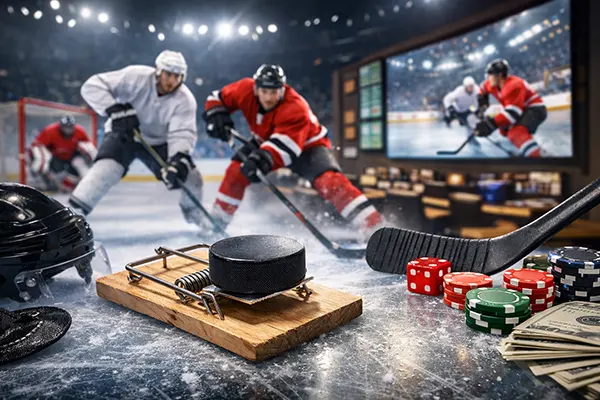
Schedule traps in 2026: back-to-backs, travel, and fatigue spots
NHL schedules create “spot” disadvantages that don’t always show up in season-long rankings. Back-to-backs, long road trips, and time-zone jumps can reduce pace, sharpen mistakes, and change coaching decisions—particularly around goaltending and defensive structure. The market does account for scheduling, but it does not always price it perfectly, because many bettors still anchor on reputation and headline form.
Back-to-back sets are an obvious example. Most teams face roughly a dozen such sets across a season, with meaningful variation depending on the schedule. A strong favourite on the second night of a back-to-back is often less dominant than the public expects, especially if travel is involved. In those cases, the favourite may still be more likely to win, but the short price can become far less attractive.
It is also worth noting that the league’s wider planning is shifting. The NHL and the NHLPA have reported changes tied to the next labour agreement, including a move to an 84-game regular season beginning in 2026–27. More games can mean more tight scheduling clusters, which increases the importance of rest, rotation, and workload management when evaluating favourites.
A pre-bet checklist that protects you from the “obvious favourite” trap
Start with context, not the badge on the shirt. Is the favourite rested? Are they travelling? Is it a back-to-back? Are they coming home after a trip, or starting one? Then compare this with the opponent’s spot. A rested underdog at home can turn a “clear mismatch” into a coin-flip game that is priced like anything but a coin flip.
Next, look at how the favourite wins. If their edge depends on the power play but the opponent is disciplined, the advantage shrinks. If their game is built on heavy forechecking and long offensive-zone shifts, fatigue can blunt that identity. If they play high-event hockey, you are buying variance—exactly what you want to avoid when the price is short.
Finally, decide whether you are comfortable if the match is still level late in the third. If your confidence evaporates the moment you imagine overtime, that is a sign the price is doing too much of the emotional work. Sometimes the best decision is to pass and wait for a number that actually compensates you for hockey’s reality: the better team does not always control the ending.